Being a GP educational supervisor (ES), also known as GP trainer, is a unique opportunity to shape the future of primary care. You can guide and equip aspiring GPs and multi-professional primary care learners with the skills and confidence.
Before starting an application, you may want to discuss the process with your associate dean or training programme director: The associate deans contact information is located below and they will be happy to discuss expectations and eligibility to train as an ES, the training requirements and the application process.
Birmingham and Solihull
Dr Sarabjit Soorae
Black Country
Dr James Bullock
Coventry and Warwickshire
Dr Elizabeth Hodges
Herefordshire and Worcestershire
Dr Anil Joshi
Staffordshire and Shropshire
Dr Heather Lodge
General admin queries
NHSE Primary and Community Care
Train the trainer courses
Anyone interested in becoming an ES in the West Midlands must first complete the train the trainers course run by the GP school.
The West Midlands train the trainers course will consist of four days in total, normally on consecutive Thursdays, 3 of these days being face to face, and one day consisting of online learning.
There will be two cohorts a year with one in the Spring and one in the Autumn. You must be able to attend all the dates. Spaces are limited and will be offered on a first come, first served basis, with a waiting list in place.
The next course dates are:
- 5 November 2026 - Venue (TBC)
- 19 November 2026 - Venue (TBC)
- 26 November 2026 - Venue (TBC)
You can apply for the next train the trainers course for associate dean approval.
What is an educational supervision?
The completion of the RCGP ePortfolio is central to the workplace-based assessment (WPBA) of GP resident doctors. The educator to whom they will be attached in their final (ST3) year of their training usually becomes the educational supervisor from the start of their training.
This involves feedback on their ePortfolio and meeting every six months to carry out a formal review of the ePortfolio entries, make judgments about their progress towards the required competencies and complete an educational supervisor's report (ESR).
What is a clinical supervision?
Clinical supervisors oversee the day-to-day work of the doctors in GP training during that placement. They are expected to:
- be the initial point of contact in issues relating to the specific post
- hold formative meetings with the doctor in GP training at the beginning, middle and end of their placement
- use WPBA assessment tools as learning opportunities, formative assessments and to provide evidence towards the record of competence progression collected in the training ePortfolio
- complete a clinical supervisors report (CSR) at the end of the placement (if a doctor in GP training is in an integrated post working concurrently in more than one specialty, then each clinical supervisor will complete a CSR
- identify resident doctors who are struggling at work or with the e-portfolio and flag this up with the training programme
Approval as a trainer
After completing an NHS-England-approved educational supervisor course
Having completed an NHS England-approved educational supervisor course, a prospective ES must then:
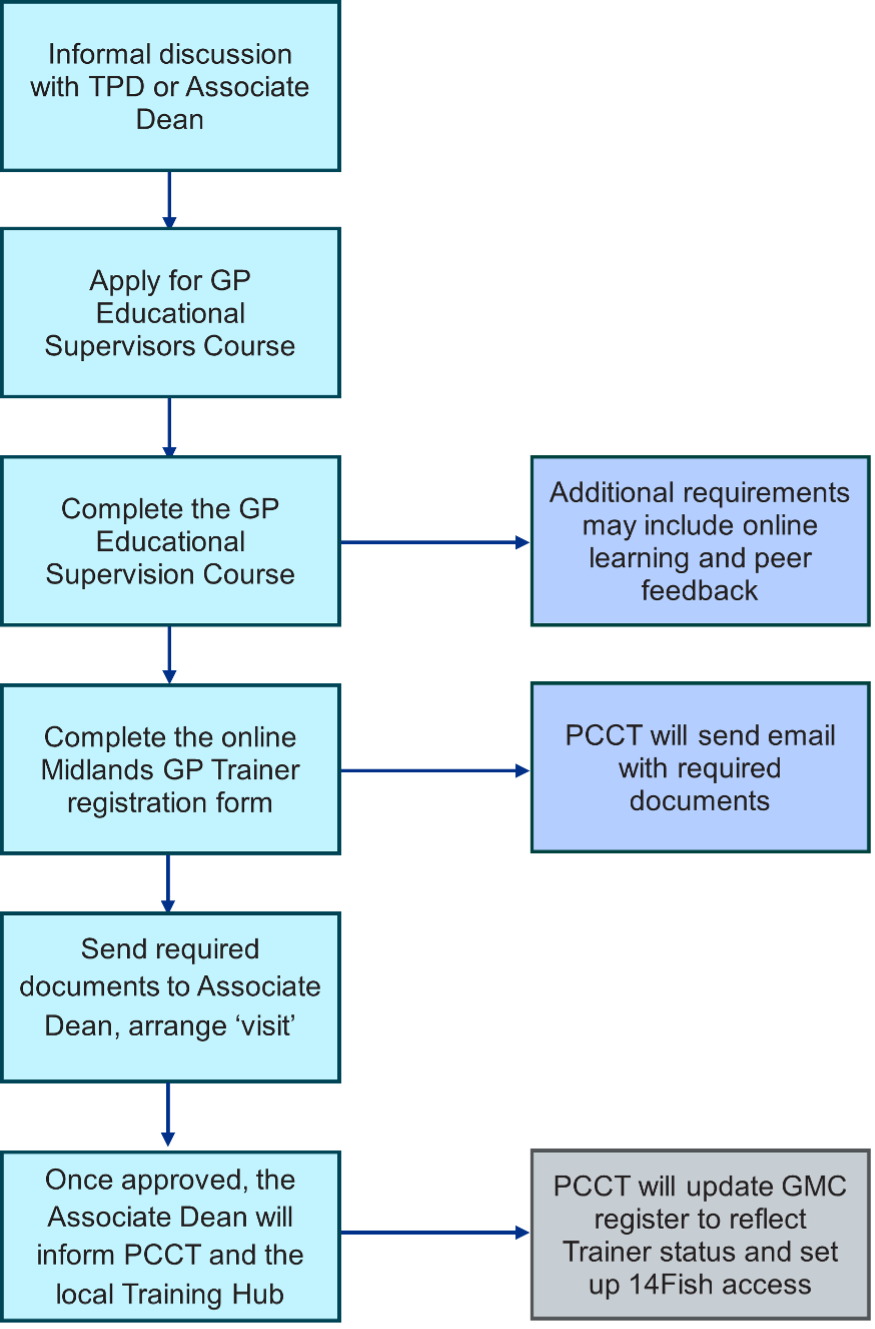
1. Complete the online Microsoft form to apply for formal approval as a Midlands GP educational supervisor (You will receive an email confirming receipt of your application).
2. Complete the Multi-professional educator approval (M-PEAT) self-assessment form (which will be attached to your email confirmation) and return it to the associate dean who will review your application (who will also be copied into your email confirmation).
3. Provide additional documents to the associate dean ahead of your formal review, including your:
- valid NHS equality, diversity, and inclusion training certificate (or other evidence of completion)
- copy/copies of relevant supervisor course certificate/s
- weekly supervisor timetable demonstrating protected time for teaching and supervision
- organisational induction booklet
- induction timetable for learners
- weekly timetable for learners
4. Once completed, you'll need to arrange a formal review meeting with the specified associate dean.
5. After the meeting, the associate dean will share their report and, if appropriate, confirm their recommendation to the Midlands' primary and community care team (PCCT) to update the General Medical Council (GMC) register and ePortfolio.
Please note: If the learning environment the prospective ES is linked to (for example, GP practice) has never previously been approved as a site for GP training, it must undergo a Training Hub-facilitated process for multi-professional LE approval.
Figure 1: Flow chart of the approval process to become a Midlands GP educational supervisor.
Eligibility to train
To be eligible to apply for any route you must have Membership of the Royal College of General Practitioners (MRCGP) and be working a minimum of four clinical sessions in a GP practice, or five clinical sessions if the sole trainer in the practice.
The practice must already be an established GP training or one which will support you and become an approved learning environment and increase/maintain training capacity. Learning environment approval is via the local Training Hub.
We encourage you to consider studying for a PGCert in Medical Education as part of your professional development as a GP educator, however this is optional.
Reapproval
From 19 June 2025, the GMC no longer require formal reapproval of trainers every five years as a minimum.
In line with this, to ensure continued delivery of quality supervision per our duties as the Local Education Provider (LEP), the Midlands GP schools are moving to an annual affirmation survey where all current GP trainers confirm their continued status as a trainer, along with their attendance at educational activities to continue development as a trainer, and other information relevant to maintaining their recognition.
The form is being developed by senior educators from the East and West Midlands GP schools.
Staying up to date as a GP educator
Your educator role should form part of your annual appraisal, and you should undertake CPD to keep updated and current. Please ensure you are on the mailing list with your local training programme and the foundation programme so that you receive information and invites to educator events, including workshops and conferences.
Each area will run regular trainers' workshops, and sub-regional workshops and the expectation is that as an educator you will attend the majority of these to keep up to date.
There is also an opportunity to attend Annual Review of Competency and Progression (ARCP) panels which can be a useful for you to be aware of and will help you support your GP registrar.
Please contact the assessments team stating that you are an educator and which area you train in and that you would like to observe an ARCP panel. These are held virtually on MS Teams on Thursdays throughout the year. There is currently a waiting list to observe.
Become an approved learning environment for GP training
From June 2025, the learning environment (LE) approval process must be completed for any LE not previously approved for GP training.
Find out more on our become an approved learning environment pages.
Practices that have previously been approved for GP training, and currently host GP resident doctors, are not required to undertake the LE approval process.
The responsibility for the approval and ongoing quality monitoring of the LE has moved to training hubs. The application to become an approved LE is made by a practice, or by a group of practices based within the same primary care network, to the relevant training hub, separately to the approval of individual trainers.
For more information about recognition, visit the LE webpage.
Further information on the GP educator role primary care approved learning environments in the West Midlands
Find out more about becoming an approved learning environment, your local training hub details, and the GP educator role in the West Midlands, click on our pages below: